
How to Solve Visual Reasoning Puzzles Without Guessing
Name one rule at a time and check it across the whole grid. An option that fits one row may fail once you check shape, position, count or direction in another row.
Fictional story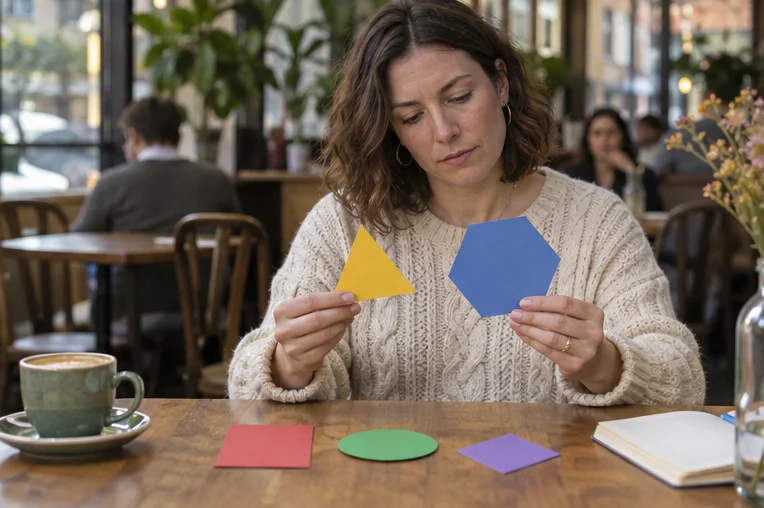
What to try
- Write down one feature that changes, then test the same rule against another line of the puzzle.
- When two options still seem possible, find the one feature they disagree on and test that feature separately.
The first pattern she saw
At a café, Casey and a friend worked through a few printed puzzles. Casey chose a tile that looked like the others. Her friend asked how the pattern changed across the row, and she realized she could describe the shapes but had not checked what happened to their positions.
Checking one rule at a time
On the next puzzle she noted which feature changed first. She tested whether the pieces rotated, then counted how many filled shapes appeared. One option matched the rotation but broke the count. Another fit both and also worked when she checked the columns.
A rule with an exception
She tried the same strategy on a puzzle with evenly spaced circles. Counting worked for two rows and failed on the third. Casey first assumed she had miscounted. Her friend suggested tracing which part of each tile had changed. Once Casey checked the outlines as well as the filled centers, she saw that her first rule had been incomplete.
Knowing when to move on
A later puzzle stayed unclear. Casey wrote down the rule that seemed most likely and moved to the next one. When she returned, she spotted a symmetry she had missed. Nothing had changed on the page, but looking away had made it easier to try a different approach.
Comparing two attempts
A week later Casey tried another set by herself. When she reviewed the results, several missed items shared a feature: she had made a good guess and stopped checking once one answer looked plausible. She wrote the most common failure next to her score so she would have something more specific to practice the next time.
Use the score as practice feedback
A visual reasoning result reflects the tasks in that set. Compare which kinds of questions felt straightforward and where checking a second rule made a difference.
What should I review after a visual reasoning quiz?
Look for the kind of error that repeats, such as stopping after the first plausible rule. That gives you a specific strategy to practice alongside your overall score.
Further reading
- How to Make a Group Decision When Everyone Has Different Priorities
Explore a related situation and a different assessment.